Pregnancy Week 8: The Final Embryonic Stretch
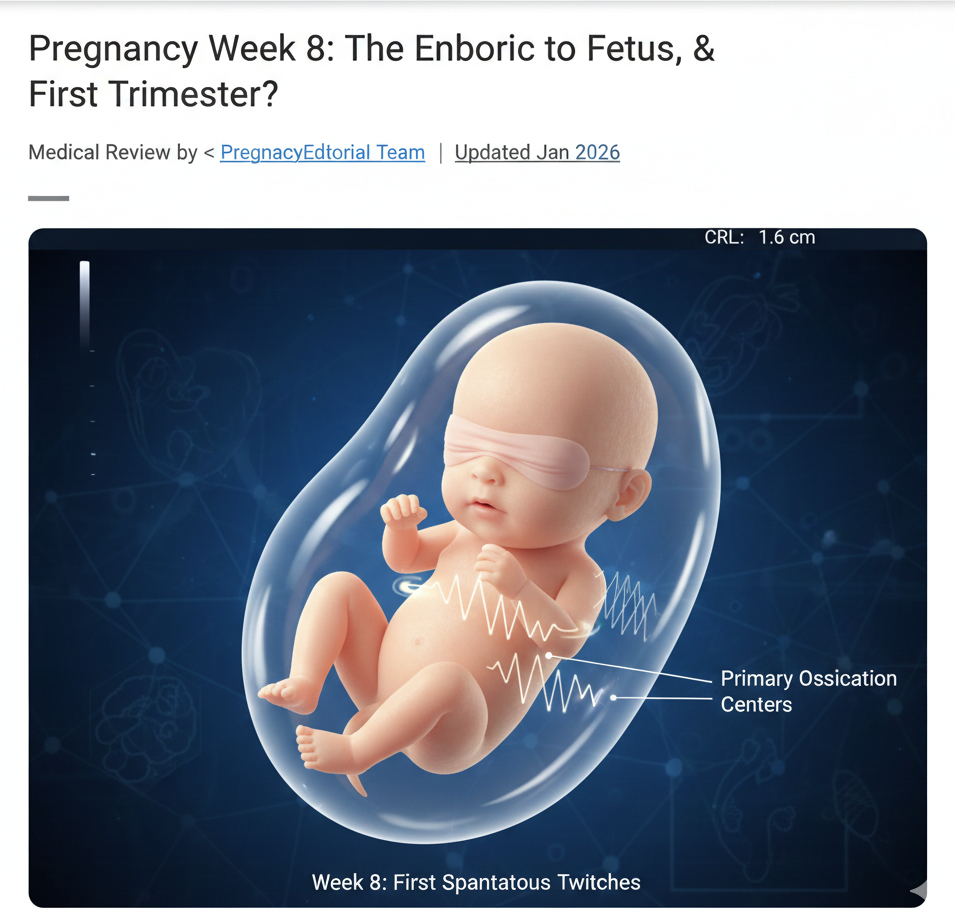
Visualizing Week 8: Notice the straightening of the body and the first primary ossification centers.
Welcome to Week 8! This week marks a significant biological graduation. Your baby is wrapping up the "embryonic" stage and preparing to officially become a "fetus" next week. Now the size of a Raspberry, the baby is losing its tadpole-like appearance as the embryonic tail is reabsorbed and the skeleton begins the fascinating process of hardening.
Baby's Size: Raspberry (~1.6cm / 0.6 inches)
Major Milestone: Tail Disappears & Eyelids Form
Movement: First spontaneous, involuntary twitches
Skeletal Status: Initial Bone Ossification
Section 1: Filling the Gap — The Disappearing Tail
A frequent "Content Gap" in early pregnancy guides is the lack of explanation regarding the embryonic "tail." During the early weeks of development, every human embryo has a small tail-like extension of the spinal column. By Week 8, this structure is almost entirely reabsorbed through a process of programmed cell death.
This allows the coccyx (tailbone) to take its final shape. As this tail disappears, the baby's body begins to straighten out from the tight C-shape seen in previous weeks, making them look significantly more human in their silhouette. http://googleusercontent.com/image_generation_content/4
Section 2: The Skeleton — From Cartilage to Bone
Until now, your baby’s "skeleton" has been made entirely of soft, flexible cartilage. In Week 8, a process called Ossification begins. Primary ossification centers appear in the long bones, such as the humerus (upper arm) and femur (thigh).
While the bones are still very soft and will remain somewhat flexible until well after birth, this is the week where the foundation of the musculoskeletal system is locked in. This is also why your body's demand for calcium begins to subtly increase, even though the baby is still quite small.
Section 3: Filling the Gap — Spontaneous Movement
Most competitors focus solely on what the baby looks like, but they miss the "action." Week 8 is the start of spontaneous movement. Because the brain and muscles are now connected by a growing network of nerves, the embryo begins to make tiny, jerky, involuntary twitches.
These movements are not controlled by the baby's will; they are "test fires" of the nervous system. You won't feel these for many weeks yet—the baby is still floating in a relatively large amount of amniotic fluid—but on a high-resolution ultrasound, you might catch a glimpse of these first "shivers" of life.
Section 4: Facial Refinement — Eyelids and Ears
The face continues its rapid transformation this week. The eyelids are now forming and will soon fuse completely shut, remaining that way until the late second trimester to protect the developing eyes.
The external ears are also moving into their final position on the head. Inside the mouth, the tiny tip of the nose is becoming more distinct, and the upper lip is forming. Even the tiny buds that will become the "milk teeth" are beginning to develop deep within the gums. http://googleusercontent.com/image_generation_content/5
Section 5: Symptoms — The "Peak" of the First Trimester?
For many women, Week 8 and Week 9 represent the peak of pregnancy symptoms as hCG levels continue to climb toward their maximum.
| Symptom | The Biological Reason | Management Tip |
|---|---|---|
| Sciatic Nerve Pain | The expanding uterus can occasionally press on the sciatic nerve. | Try "Pelvic Tilts" or side-sleeping with a pillow between your knees. |
| Heightened Dreams | Rising progesterone levels affect REM sleep and emotional processing. | Keep a dream journal; it’s a fun way to document this hormonal phase. |
| Varicose Veins | Increased blood volume and progesterone relaxing vein walls. | Avoid standing for long periods; keep your feet elevated when sitting. |
| Dizziness/Faintness | Your circulatory system is expanding faster than your blood volume. | Stand up slowly and stay consistently hydrated to maintain blood pressure. |
Section 6: Action Plan — Supporting the Hardening Skeleton
Since Week 8 is the "Week of Ossification," your nutritional focus should be on bone-building blocks:
1. Calcium and Vitamin D Duo
The baby is beginning to draw calcium from your stores to harden those tiny limb buds into bones. Ensure you are getting enough Vitamin D, as your body cannot absorb calcium effectively without it. Sunlight and fortified foods are your best friends this week.
2. Monitoring Skin Changes
You may notice your skin becoming oilier (the "pregnancy glow" or pregnancy acne) or perhaps a bit more sensitive to the sun. This is a result of increased melanocyte-stimulating hormone. Swap your regular skincare for "sensitive" versions and never skip the SPF.
Section 7: FAQ — Deep-Dive Expert Answers
Is it true my uterus is the size of a lemon now?
Actually, by Week 8, your uterus has grown from the size of a small lime to the size of a large lemon or a tennis ball. While it is still tucked behind your pubic bone, it is beginning to expand upward and outward. This expansion is what causes the frequent urination (pressure on the bladder) and the "stretching" sensations that many women mistake for period cramps.
Can I hear the heartbeat with a home Doppler yet?
It is very unlikely. At 8 weeks, the baby is still extremely small and buried deep behind the pubic bone. Most home Dopplers cannot reliably pick up a heartbeat until Week 12 or 14. Attempting to use one too early often leads to unnecessary anxiety. A medical-grade ultrasound is the only reliable way to "see" and "hear" the heart at this stage.
Why do I feel so dizzy when I stand up?
This is a very common Week 8 symptom. Your body is producing a massive amount of extra blood (eventually 50% more than usual!), but your blood vessels are also relaxing due to progesterone. This can cause your blood pressure to drop slightly, especially when you change positions quickly. To manage this, always sit on the edge of the bed for a minute before standing up and ensure you are eating small, frequent meals to keep your blood sugar stable.
What is 'Morning Sickness' vs 'Hyperemesis' in Week 8?
Week 8 is often the most difficult week for nausea. "Normal" morning sickness involves waves of nausea but allows you to keep some food and water down. Hyperemesis Gravidarum (HG) is a severe condition where you cannot keep anything down, leading to dehydration and weight loss. If you find yourself unable to tolerate even sips of water for more than 12 hours, you must contact your healthcare provider for support.
Essential Tools for Week 8
👉 Use our Due Date Calculator
👉 See the full First Trimester directory
Medical Disclaimer: This content is for informational purposes only. It is not intended to provide medical advice or to take the place of such advice or treatment from a personal physician.